From past discussions in the Bullseye-L Forum, I believe we share a common problem with inadequate indoor range lighting.
We have no control over outdoor lighting, but we do have full control to our indoor range lighting. The following was done at our range recently using the talent pool of our progressive members. We were not lighting engineers but rather concerned club members who enjoy the shooting sports.
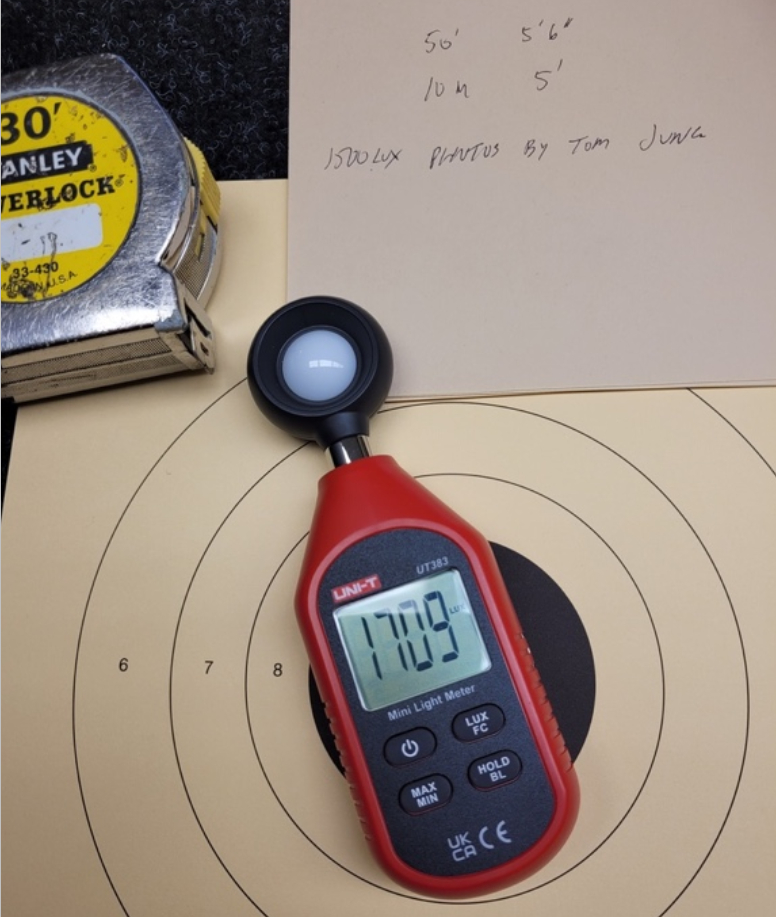
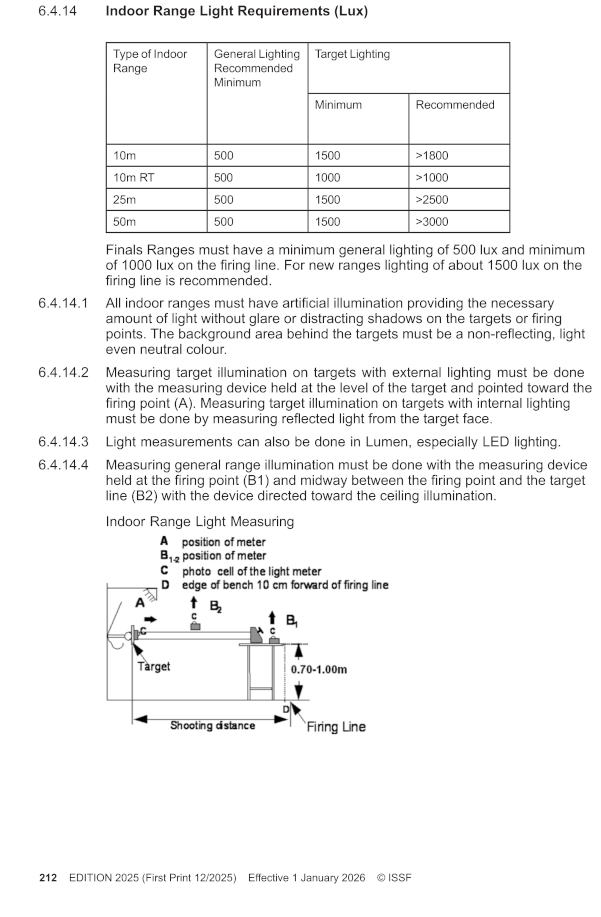
First identify the problem with the existing light sources. This could only be done with a light meter which need not be expensive. The obvious areas to check would be the target and shooting line. There were specific rules as outlined by ISSF (International Shooting Sports Federation) General Technical Rules, Light Requirements Chart 6.4.14.
Keep in mind that although light fixture specifications may be helpful, there would be many factors affecting the outcome such as distance of the fixtures, angle placement, and lighting from the adjacent fixtures. The minimum ISSF recommended requirements may seem inadequate to many shooters as it did at our club. To avoid the “cave” lighting effect, there should be adequate lighting in the middle of the range as well.
The following picture shows the original lighting at 50 feet with the older flood lights. Lanes 1 to 7 showed an average of over 2000 lux which was slightly above the minimum ISSF requirement of 1500 lux but with a recommended 1800 lux. Lane 8 had an experimental replacement fixture in place which produced 4800 lux. In our range, we also have a row of floodlights for the 10-meter air pistol/rifle targets which also boost the overall lighting at 50 feet, whenever on.
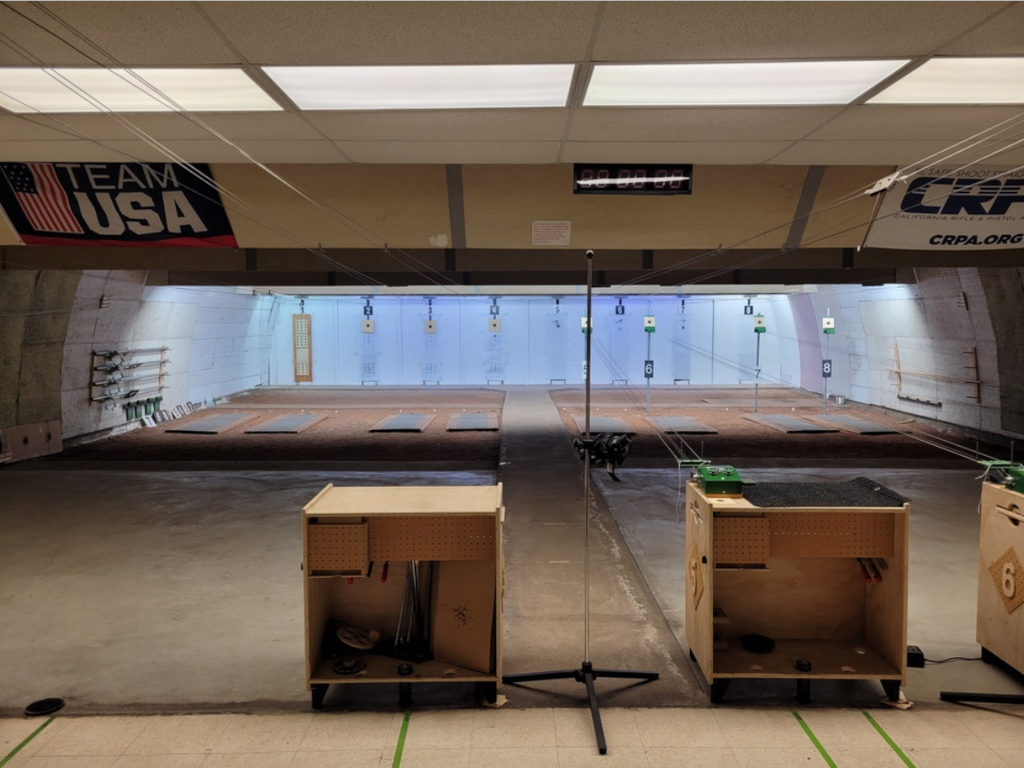
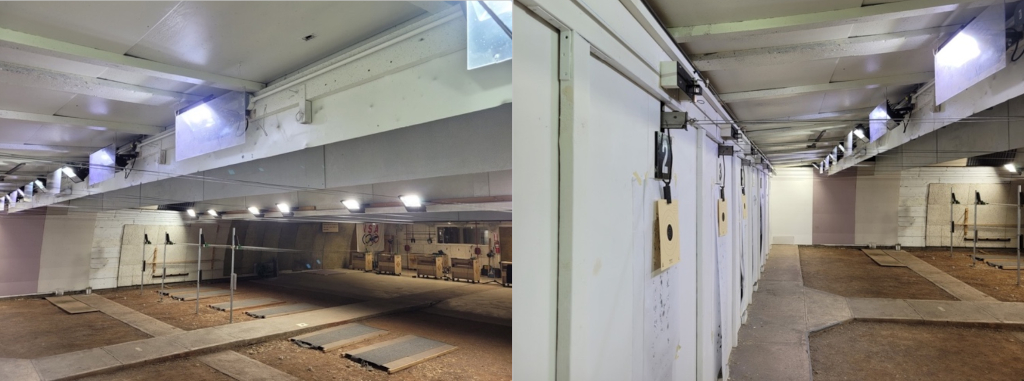
With the old lighting, note the cave effect in the middle of the range, the uneven lighting at the firing line and the rather dim lighting on top of the shooting benches. On both the 50 feet and 10-meter targets, the distance to the flood lights were approximately 5 feet. There was one light fixture for each target.
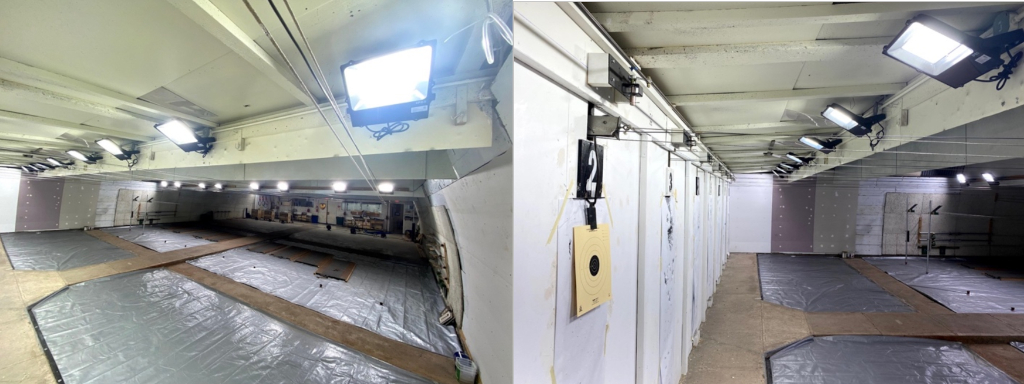
After the new floodlights were installed for the 50 feet targets, the brightness went from 2000 lux to over 5000 lux. The new floodlight specification was: 150 watts, 21,000 lumen 5000K color
The light readings with only the 50 feet lights on dropped negligibly to an average of 4480 lux, still a great improvement over the old lights. This would be more representative for most indoor ranges with only one row of new target lighting.
The old light fixtures at the firing line had fluorescent tubes of different color temperatures and a few had newer brighter LED replacements producing uneven lighting across the firing line. Replacement tubes were possibly purchased in different color temperatures, but aging will also change the color appearance. This problem may resemble many indoor ranges of the Bullseye L- Forum members.
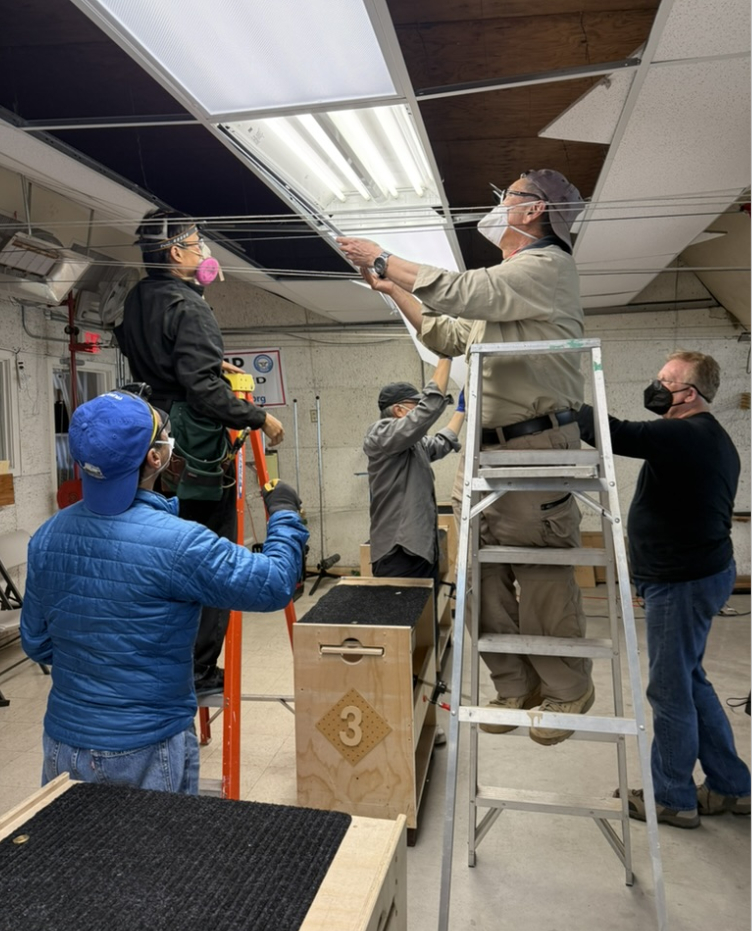
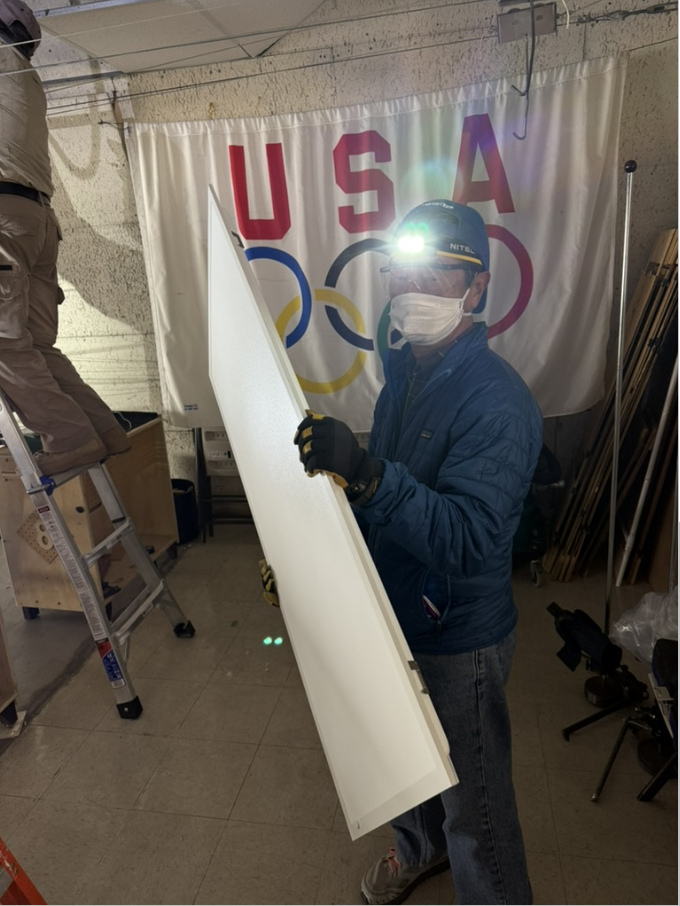
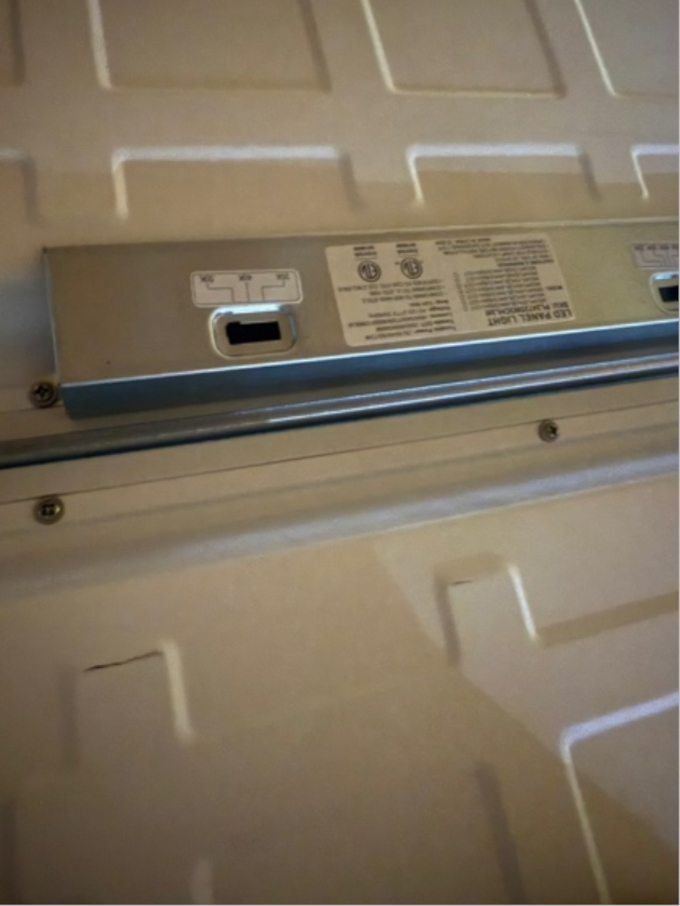
The new LED panels were more energy efficient (72W vs 128W, a 44% decrease), longer lasting with 4X lifespan (94000 hours vs 24000 hours) and about 50% brighter (12960 lumens vs 19499 lumens). We chose the 5000K color temperature, the most popular.
The panels were about 20% of the weight of the older bulkier fluorescent enclosures. These panels have adjustments for color temperature and intensity. They have a 5-year warranty.
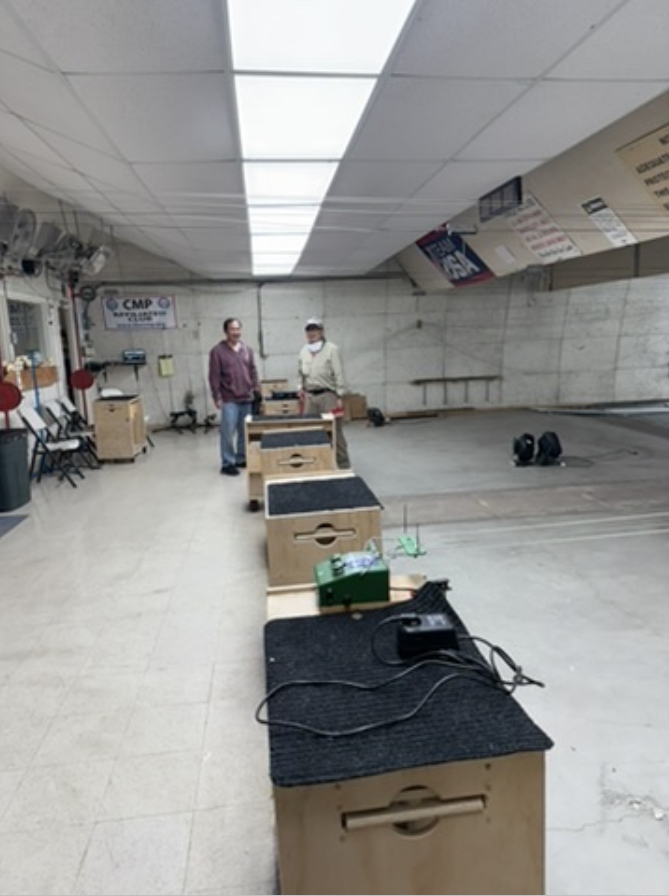
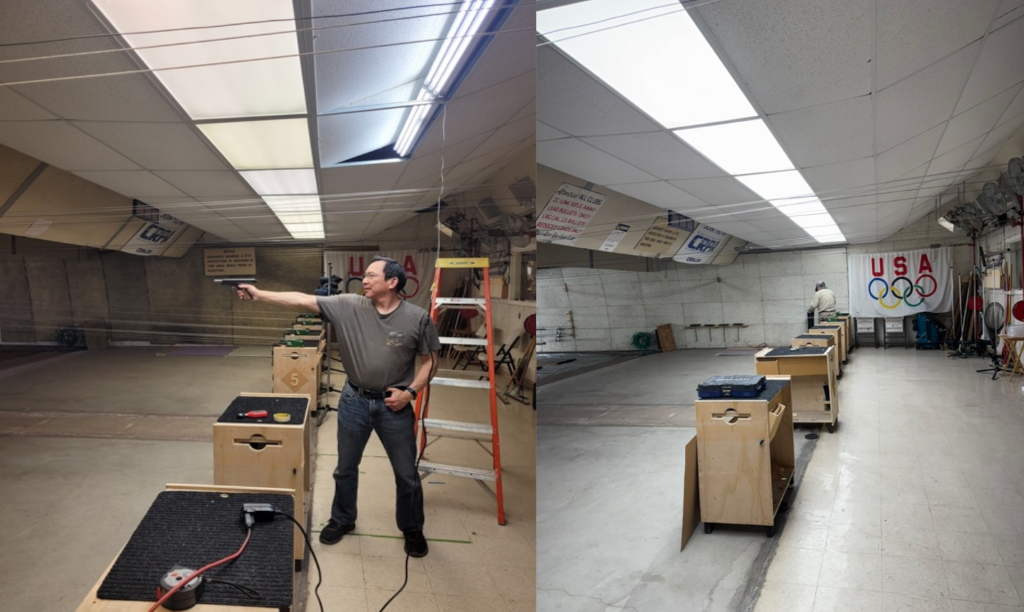
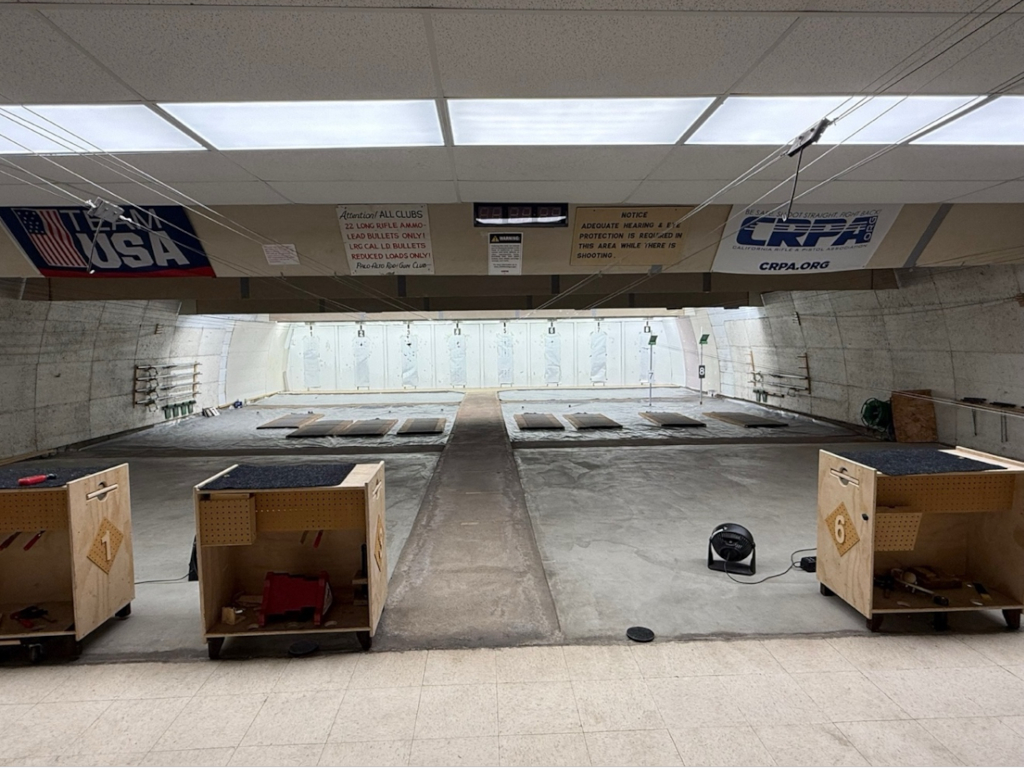
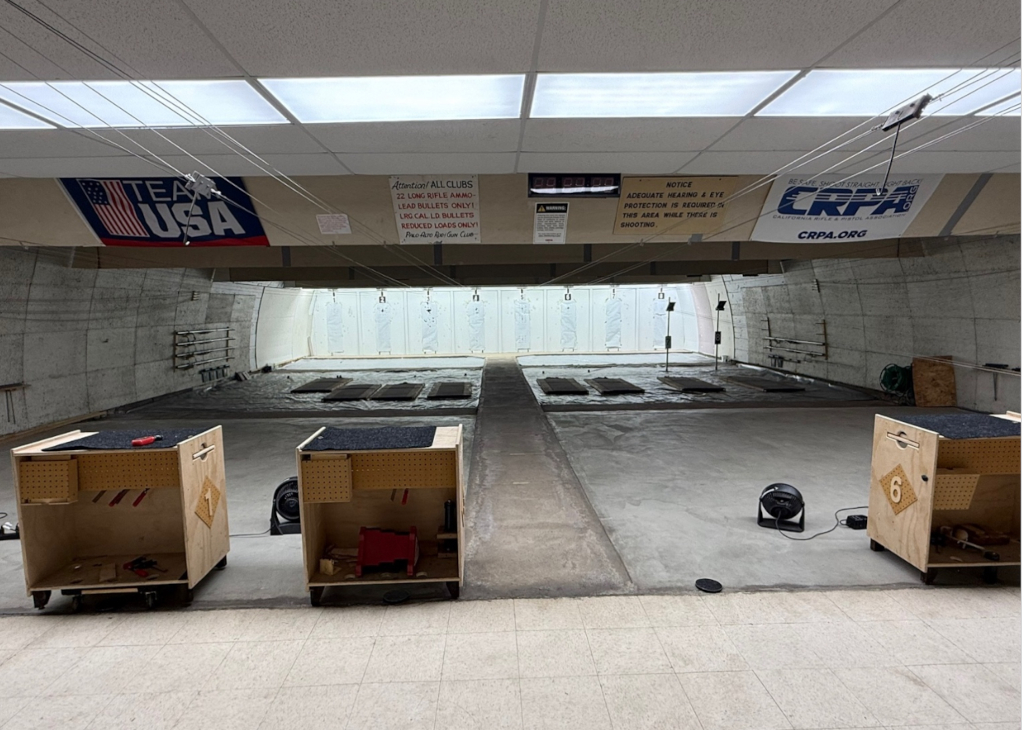
Note the illumination on the firing line before and after the light panel upgrade. These new light panels show a significant wider dispersion angle, eliminating some of the cave effect in the middle of the range. Future projects will be to include the angled light fixtures permanently with a dimmable on-off switch and more lighting in the middle of the range to eliminate the cave effect completely.
The ISSF minimum requirement at the firing line is 1000 lux. This would be measured from the top of the bench. Originally, firing points 2 to 7 measured an average of 1879 lux. Firing points 1 and 8 measured in only in the 800 lux range because there were no adjacent fixtures at the ends.
After the new LED panels were installed, firing points 3, 4, 5, 6 measured slightly over 3000 lux, points 2 and 7 at 2840 lux while only 2100 lux at end firing points 1 and 8. This was a big improvement from before and an initial comment from one of our senior shooters who struggled before was, “I can see my iron sights now.”
After much experimenting, placement of additional lighting above, behind the shooter and angled at 45 degrees provided very effective lighting upon the face of the front sight. Markings placed on the face can easily be seen, whether etch marks or colors. The angled lighting provided 1500 lux at the front sight face. Without it, there was only 400 lux. There were no suggestions for lighting at the front sight face by ISSF. Angled lighting behind the shooter was noted at the Fort Benning shooting range by Julian who had visited many first-class shooting ranges.
Julian Lin provided one of the best descriptions on color temperature selection and CRI (Color Rendering Index): “The 45-degree lights have a 5000K color temperature output as do the 10 meter and 50-foot lights. 5000K-6500K is considered direct sun light in terms of color. 5600K is considered high midday sun with no cloud covering. Higher color temperatures will correspond more closely to sunlight passing through cloud cover and have a ‘cooler’ appearance. The higher the color temperature, the greater the tendency to perceive a bluish tinge. The lower the color temperature, the warmer and more biased towards yellow the light will be.”
“Note that CRI (Color Rendering Index) is important. The CRI measures the light source's ability to reveal the true color of objects. The CRI is 85+ for the 50', 10m and 45-degree lights. That is considered 'very good' and objects will appear their true color under this light source. Anything 90+ is considered excellent and is used in settings, such as photo studios, where very accurate color discrimination is necessary. Lower CRI ratings will yield more energy efficiency. 85-90 is a good place to be without breaking the bank and giving us the most accurate color representation. Color temperature and CRI are not linked. You can have any CRI at any color temperature.”
So that one may appreciate and relate to 1500 Lux of lighting onto the face of the front sight, in my article, FRONT SIGHT ANALOGY and the FRONT SIGHT ENHANCER, pictures were taken with 1500 Lux of lighting. The photographer, a pistol shooter who had participated at the Camp Perry National Pistol Matches, was surprised with the ease he was able to see the sight picture.
FINALLY, WE NEED TO PUT ALL THESE INDOOR LUX LIGHT READINGS INTO PERSPECTIVE. FOR COMPARISON, WE FOUND AN OUTDOOR READING of 12,000 LUX DURING MIDDAY WITHOUT CLOUD COVER IN THE MONTH OF JANUARY.
The new range lights were purchased from Prime Lights. Flood lights were LED Hammerhead 150 W Gen II Adjustable Flood -21,000 Lumens. Since our installation, they have been replaced by another model. The 2’x4’ panel lights: SKU:PL-24725 W5Cbt-4-C. We added 2’ x 2’ panel lights in both ends to provide a complete ceiling wall-to-wall overage: SKU:PL-CT22-40WLED-1. This may give you a head start in searching for light fixtures for your club. We have no financial gain for mentioning this company and assume no liability. Total cost for the LED panel lights was $555 ($75 for a 2-pack of 2’x2’ and $480 for two 4-packs of 2’x4’). For the LED floodlights, they were $119 each. The grand total was $1507. We will share further upgrades in the future. Good luck and Happy New Year! Many thanks to Julian Lin and Roy Sasai for consulting, Ed Hall for editing and formatting, Ryan Kanazawa for IT consultation and Nelson Owyang with vast knowledge and expertise.
Good Vision and Good Shooting To All,
Norman H. Wong, O.D.